Managing Assets
Overview
The Overview section provides complete details of the asset.
The first row displays key identifiers and status information, including the asset’s category, asset tag, condition, ownership duration, and current status.
The second row highlights the asset name.
The third row includes the remaining asset details along with any custom fields specific to the asset’s category.
The fourth row summarizes all cost-related information, including the purchase price, warranty cost, and any event costs such as repair or maintenance expenses associated with the asset.

Current Assignments
The Current Assignments section includes a toggle: by default, it shows the assigned person and/or location, and switching the toggle displays any subscriptions linked to the asset.
Along with the name, this section will also include a badge indicating how long it has been since the assignment was made.

Timeline
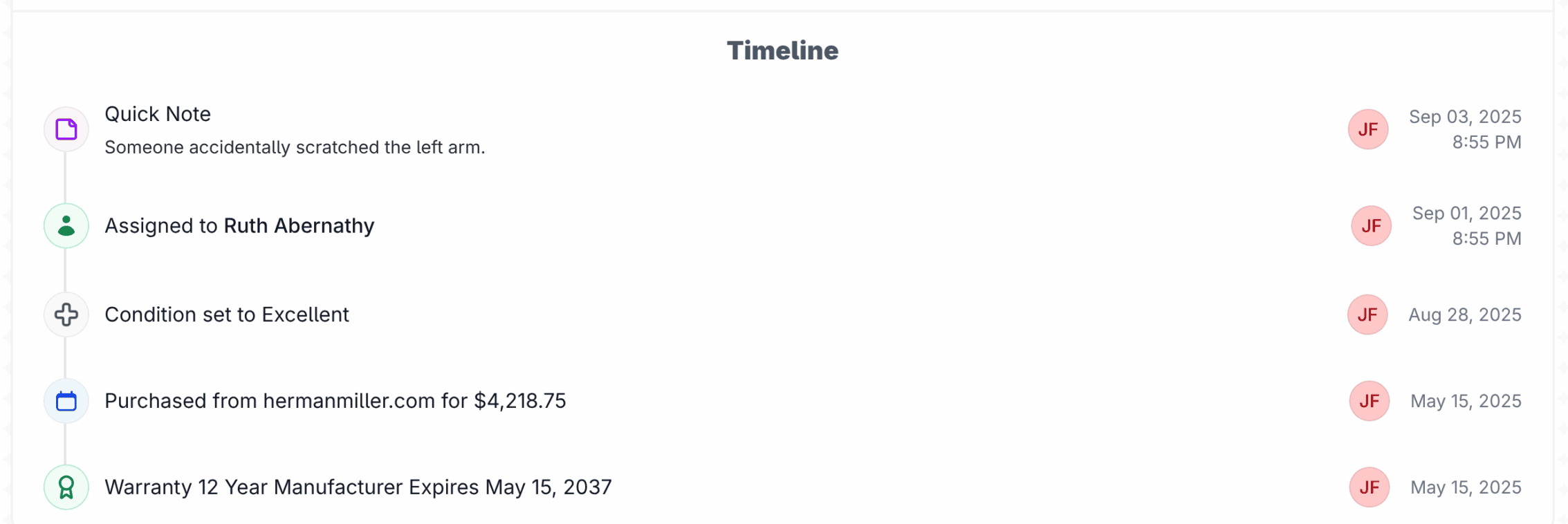
The timeline documents the complete lifecycle of each asset from acquisition through lifecycle events, to-dos, and notes, to final decommission. Every activity is recorded in one place, and each timeline entry can be edited with a single click.
Comments and attachments are supported on all timeline entries. Click on any item to edit it and you can make comments or upload attachments. Timeline items with comments will show a comment bubble icon and items with attachments will show a paperclip icon on the activity line.
Actions Button
The actions button in the top right corner is how you manage the asset. This is the only button on the page by design. Any action you need to perform on the Asset is done in the actions button.
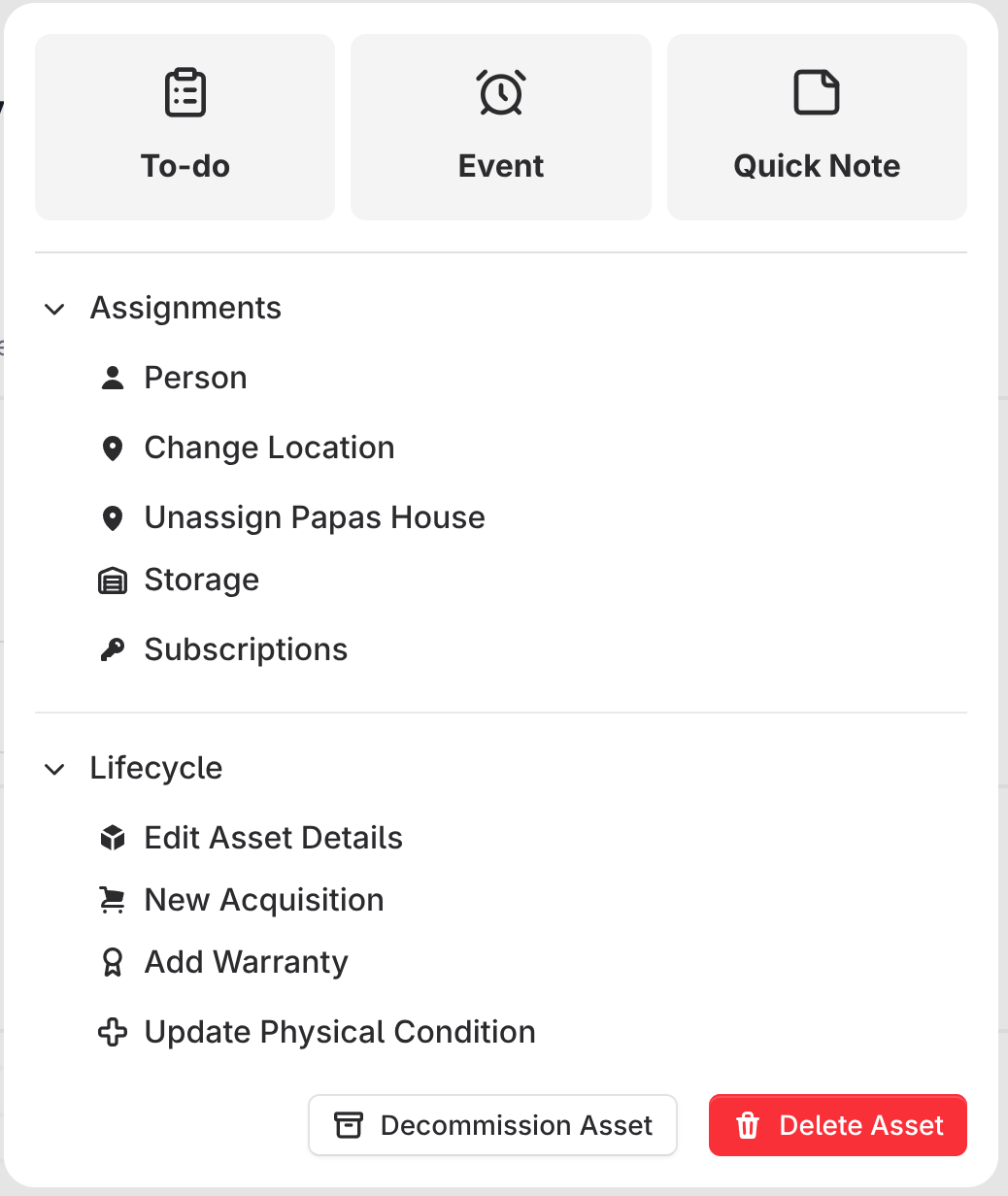
The To-do button is for recording a To-do on that asset. If something needs to be completed in the future by you or someone else this is where you create it. For example a phone needs a screen replacement, you can create a To-do for that needed repair.
The Events button is for tracking the lifecycle of the asset. The system comes with Accidental Damage, Broken, Maintenance, Repair and Vandalism. These events can be customized and you can create your own in the Asset Events setup page.
The Quick Note button is simple and straightforward. It will create a timeline entry that is a simple note. Use this for recording things like informational one off events on the asset.
Under the assignments dropdown you can assign a person, a location, subscriptions, or a storage location
Under the lifecycle dropdown. Edit Asset Details is where you update the base details of the asset such as name, manufacturer, model number, etc.
The new acquisition button is for updating the ownership information of the asset. For example a vehicle is under lease and you purchase it. The new acquisition would be the purchase.
The add or renew warranty button is for adding or renewing a warranty on that asset.
Update physical condition is for recording the condition of the asset, these can be customized but the default options are Excellent, Good, Fair, Poor and Broken.
Decommission events are for retiring the asset from use in your organization. This will remove any current assignments and update the status to whichever event you choose retired, sold, lost, etc. This item is now considered no longer in use and it will have limited options in the actions menu.